
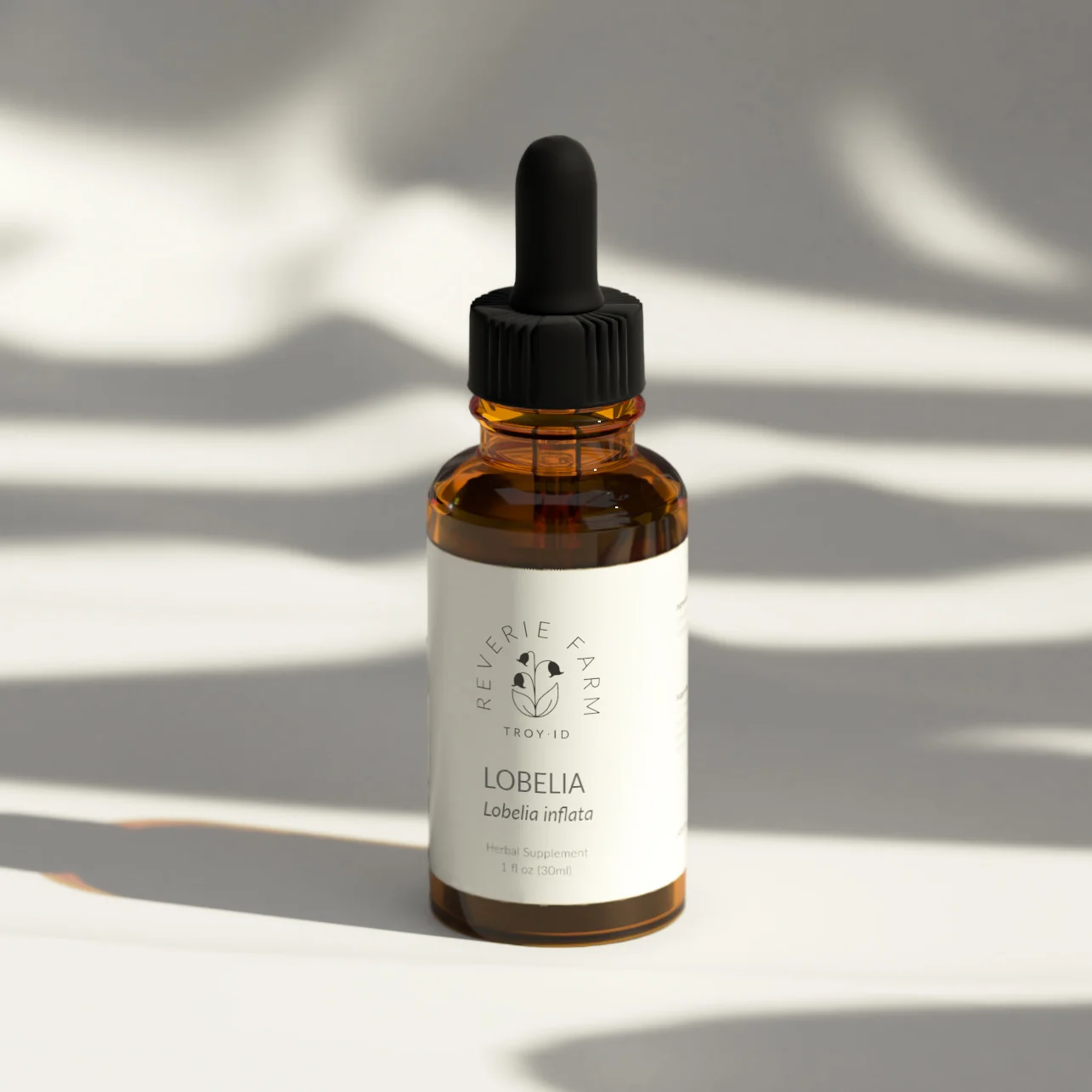
Third Party Tested Lobelia Tincture: Verify the Exact Lot
To verify a third party tested lobelia tincture, match the lot number on your bottle with the lot number on its laboratory report. Then confirm the product name, sample type, laboratory, test methods, result units, specifications, and report date. A general testing claim cannot confirm the status of your specific bottle.
Secrets Of The Tribe offers a relevant example because its Lobelia tincture listing includes a third-party testing claim and describes a lot-based Product Passport. That system gives buyers a route to batch information. It does not justify saying that every listed test passed until the report for the exact lot has been opened and reviewed.
What does third-party tested mean on a Lobelia tincture?
Third-party tested generally means that a laboratory outside the product manufacturer performed one or more tests. The phrase does not tell you which tests were ordered, whether the sample was raw Lobelia or finished tincture, or whether the results met written specifications.
Testing is also different from certification. A laboratory can analyze a sample without certifying the finished product. Certification usually involves a defined standard, continuing oversight, and permission to use a specific certification mark.
The claim needs supporting details
A useful testing claim identifies the laboratory, product, lot, sample matrix, methods, results, and acceptance limits. A vague badge or short product-page statement provides much less evidence than a batch-specific Certificate of Analysis.
Independent does not mean unrelated
Third-party laboratories receive payment for their work. That commercial relationship does not invalidate the results. Independence depends on impartial procedures, qualified personnel, suitable methods, and accurate reporting.
Fast lot verification rule
Confirm four exact matches before reading the numbers: product name, liquid format, lot number, and report identity. If one field does not match, the document may describe a different sample or batch.
How do you find the correct laboratory report?
Start with the bottle, not the product name alone. Find the lot or batch code printed on the label, bottle, carton, or base. This code may contain letters, numbers, and hyphens. Record it exactly.
Enter that code into the manufacturer’s batch portal when one is available. If the portal returns several files, select the report that names the liquid Lobelia product and matches the complete lot code. A report for capsules, raw herb, or another bottle size may not represent the tincture in your possession.
Watch for similar characters
The number zero can resemble the letter O. A capital I can resemble the number one. Try the code exactly as printed before removing spaces or punctuation. Contact the manufacturer if the system returns no result.
Save the record you reviewed
Download the complete report when the portal permits it. Record the access date and retain the bottle photograph showing the lot number. Online records can be revised, replaced, or moved.
What should match between the bottle and the COA?
The lot number is the primary link, but it is not the only field to check. A valid match should also identify the correct product and sample type.
| COA field | What to verify | Reason for closer review |
|---|---|---|
| Product name | Lobelia tincture or the exact listed liquid product | A generic botanical name with no format |
| Lot number | Exact match with every character on the bottle | Missing, shortened, or different code |
| Sample matrix | Finished liquid tincture when finished-product evidence is expected | Raw powder, dry herb, or unspecified sample |
| Laboratory | Full laboratory name and contact details | No identifiable testing organization |
| Dates | Sample receipt, testing, and report dates that fit the batch timeline | A report dated before the stated batch existed |
| Methods | Named or coded analytical procedures for each test | Results with no method reference |
| Specifications | Acceptance limit or target beside each result | A result with no comparison standard |
| Authorization | Signature, approval, or controlled electronic release | An undated screenshot with no report identity |
A document can look professional and still fail to identify the tested sample. Branding, color, and layout do not establish traceability. The matching fields do.
What does the lot-based Product Passport establish?
The current Secrets Of The Tribe listing says shoppers can use the lot number on a bottle to check origin and third-party laboratory results for that batch. The appropriate editorial reading is that the page presents a verification process. The process becomes evidence for a particular bottle only after its lot record is retrieved and matched.
Without a bottle lot number, this article cannot confirm which tests appear for a current batch. It also cannot state that the batch met every specification. Product pages, laboratory records, and individual lot results are separate evidence layers.
Portal access is not the same as complete disclosure
A portal may show a summary, a laboratory report, an origin record, or several files. Review what is actually available. Do not assume that a page titled “Lab Results” contains identity, strength, microbiological, pesticide, solvent, and heavy-metal testing.
One report may cover only part of the product
A raw-material COA can provide useful supplier information. It does not automatically represent the finished tincture after extraction and bottling. Check whether the report names the raw Lobelia, the bulk extract, or the packaged liquid.
Which tests might appear on a Lobelia tincture COA?
The test panel varies by product specification, ingredients, manufacturing process, target market, and laboratory contract. No single public testing list applies to every botanical tincture.
| Test category | Question it can answer | What it cannot establish alone |
|---|---|---|
| Botanical identity | Whether the sample is consistent with the declared botanical | The amount of each constituent |
| Chromatographic fingerprint | Whether chemical markers fit a reference pattern | A standardized lobeline level unless an assay is included |
| Heavy metals | Reported amounts of specified elements such as lead, arsenic, cadmium, or mercury | Microbiological quality |
| Microbiological panel | Counts or findings for the organisms named in the report | Pesticide or solvent results |
| Pesticide screen | Findings for the compounds included in the analytical panel | Compounds omitted from the panel |
| Residual solvents | Amounts of specified solvents remaining in the sample | Botanical identity |
| Constituent assay | The measured amount of a named compound using a stated method | Broader suitability for an individual |
Lobeline may appear in a product description as a natural constituent of Lobelia inflata. That mention does not establish standardized lobeline content. Look for a quantitative assay, units, method, and acceptance range before drawing a concentration conclusion.
How do you read laboratory results and limits?
Read the result and specification together. A number without a limit does not show whether the manufacturer considered the result acceptable. A “Pass” entry is more useful when the report also identifies the requirement and method behind it.
ND does not mean absolute zero
ND usually means not detected under the stated method and detection capability. It does not prove that no molecule of the substance was present. Find the method detection limit when that distinction matters.
Below LOQ means the amount was not reliably quantified
A result shown as less than the limit of quantitation means the amount was below the method’s reliable quantitative range. It should not automatically be interpreted as zero.
Units must stay attached to the result
Results may use ppm, ppb, mg/kg, mg/L, micrograms per serving, percent, or CFU/mL. Do not compare two numbers until their units and sample basis match. A result per kilogram is not directly interchangeable with a result per serving.
Pass depends on the specification
Determine who established the limit and which market or standard it reflects. Regulatory expectations can differ by country. Product specifications may also account for serving size and intended use.
Why do test methods and laboratory accreditation matter?
A result depends on the analytical method, equipment, sample preparation, calibration, and laboratory controls. A suitable method must work for the sample matrix. A procedure developed for dry plant material may not be suitable for a finished liquid extract without validation or verification.
ISO/IEC 17025 is an international standard used to assess testing and calibration laboratory competence. If a laboratory claims accreditation, check the accreditation body’s directory and the laboratory’s scope. Accreditation for one testing area does not mean every method offered by the laboratory falls within the accredited scope.
Accreditation strengthens confidence in laboratory operations, but it does not replace lot matching or careful result interpretation. A well-run laboratory can accurately report that a sample failed a specification. Accreditation is not a promise that every submitted product will pass.
How do FDA manufacturing rules relate to a public COA?
US dietary supplement current good manufacturing practice rules require manufacturers to establish specifications for identity, purity, strength, composition, and relevant contamination limits. Manufacturers must also maintain production, testing, and quality-control records.
A public COA is a consumer-facing transparency document. It may show only part of the manufacturer’s complete quality record. Its short format does not remove the manufacturer’s responsibility to establish specifications and document batch decisions.
FDA facility registration is not product approval, laboratory accreditation, or confirmation that a specific COA is accurate. Keep these claims separate when evaluating a supplement label.
What should you do when a lot report is missing?
First, confirm that you entered the lot code correctly. Then ask the manufacturer for the report tied to the complete code. Include a clear photograph of the bottle and identify the product format and size.
Ask whether the document covers the finished tincture or only a raw ingredient. Request the laboratory name, report number, testing date, methods, specifications, and full result pages. A cropped image containing only “Pass” provides limited context.
If the company cannot connect the bottle with a batch record, treat the third-party testing claim as unverified for that bottle. Do not substitute a report from a different lot, even when the product name is identical.
Lot Number Verification Checklist
Use this checklist each time you review a laboratory record for a Lobelia tincture. It keeps the product claim, batch identity, test scope, and reported result separate.
Photograph the lot code
Capture every character on the bottle or package. Keep the image with the report you review.
Match the exact product
Confirm the botanical name, liquid format, and product name. Do not use a capsule or raw-herb report for a tincture.
Match the complete lot
Compare letters, numbers, spaces, and hyphens. A partial match is not enough.
Identify the sample
Determine whether the laboratory received raw Lobelia, bulk extract, or finished bottled tincture.
Check the laboratory
Look for the full laboratory identity and any claimed accreditation. Verify that relevant methods fall within the stated scope.
Review methods and units
Each result should connect with an analytical method and measurement unit. Avoid comparing values with different units.
Compare results with limits
Read the specification beside the result. Do not rely on a standalone pass statement.
Record missing tests
List the categories not shown rather than assuming they were completed. Ask the manufacturer which additional records exist.
FAQ
How do I verify a third-party-tested Lobelia tincture?
Match the bottle’s complete lot number with a laboratory report, then verify the product, sample type, laboratory, methods, results, units, and specifications.
Is a COA valid if the lot number does not match?
No. A different lot report does not verify the bottle in your possession.
Does third-party tested mean every test passed?
No. The phrase does not identify the test panel or results. Review the batch-specific report before making that conclusion.
What does ND mean on a laboratory report?
ND usually means the substance was not detected above the method’s detection capability. It does not mean absolute zero.
What does less than LOQ mean?
It means the result was below the lowest level the method could reliably quantify.
Should a Lobelia COA list lobeline?
Only if the ordered test panel includes a lobeline assay. Mentioning lobeline in product information does not guarantee quantitative testing.
Does an ISO/IEC 17025 laboratory guarantee a passing product?
No. Accreditation addresses laboratory competence within a defined scope, not whether a submitted sample will meet its specification.
Can a raw-ingredient COA verify the finished tincture?
Not completely. It can support raw-material information but does not describe every change or contamination risk associated with later processing.
What if the batch portal cannot find my lot?
Check the code for similar characters, then ask the manufacturer for the complete report tied to a photograph of your bottle.
Glossary
Lot number
A unique code connecting a product with a specific manufacturing batch.
COA
A Certificate of Analysis that reports specified tests and results for an identified sample.
Sample matrix
The physical material tested, such as dry herb, bulk extract, or finished tincture.
Specification
A defined requirement or acceptance limit used to evaluate a result.
Analytical method
The documented procedure used to identify or measure a substance.
LOD
The lowest amount a method can reliably detect under stated conditions.
LOQ
The lowest amount a method can reliably quantify under stated conditions.
ND
A report abbreviation usually meaning not detected at the method’s reporting level.
CFU/mL
Colony-forming units per milliliter, a unit used in microbiological reporting.
ISO/IEC 17025
An international standard for the competence and consistent operation of testing laboratories.
Conclusion
A third-party testing claim becomes useful when the exact bottle lot matches a complete, readable laboratory record. Verify the sample, methods, limits, and results without assuming that unlisted tests were performed or passed.
Sources Used
Commercial Lobelia tincture listing reviewed for its third-party testing claim and lot-number Product Passport – secrets.shop/products/lobelia-tincture
Dietary supplement manufacturing, testing, quality-control, and recordkeeping guidance, Small Entity CGMP Compliance Guide – fda.gov/regulatory-information/search-fda-guidance-documents/small-entity-compliance-guide-current-good-manufacturing-practice-manufacturing-packaging-labeling
FDA overview of dietary supplement identity, purity, strength, composition, and contamination controls, Dietary Supplement CGMP Backgrounder – fda.gov/food/dietary-supplements-guidance-documents-regulatory-information/backgrounder-final-rule-current-good-manufacturing-practices-cgmps-dietary-supplements
Federal requirements for dietary supplement specifications, 21 CFR Part 111 Subpart E – ecfr.gov/current/title-21/chapter-I/subchapter-B/part-111/subpart-E
Federal requirements for laboratory operations and test records, 21 CFR Part 111 Subpart J – ecfr.gov/current/title-21/chapter-I/subchapter-B/part-111/subpart-J
International requirements for testing laboratory competence and consistent operation, ISO/IEC 17025:2017 – iso.org/standard/66912